
Pest control franchises give first-time owners a way into a steady, in-demand industry with a proven system behind them. Bugs don’t take a year off, so demand holds up even when the wider economy slows.
This guide explains what these franchises are, what they cost, how profitable they can be, and how to compare brands. You will also learn the steps to open your own.
Key Takeaways
- A pest control franchise lets you run a local business using an established brand’s proven system and support.
- Total initial investment runs about $40,500–$127,700 for Mosquito Authority and $40,500 to $105,700 for Pest Authority, with fees and royalties on top.
- Recurring service contracts drive profit. Mosquito Authority’s disclosure document reports an average gross revenue of $464,599.95 across 128 franchisees (a historical average, not a guarantee).
- Federal rules require a 23-item disclosure document, delivered at least 14 days before you sign or pay.
- You can choose mosquito-only service or full-service pest protection under one franchise family.
What Is a Pest Control Franchise?
A pest control franchise lets you buy the right to operate under an established brand, using its name and proven operating system. You own and run the local location, and the franchisor supplies the model, training, marketing, and ongoing support.
Two costs define the deal. The franchise fee is a one-time upfront payment for the right to join the brand. A royalty is an ongoing fee, usually a percentage of your revenue, paid to the franchisor for continued brand use and support.
Compare that with starting a pest company on your own. A franchise gives you brand recognition, tested methods, financing help, and hands-on support from day one, so you skip much of the trial and error. That structure is the core of a pest control franchise opportunity.
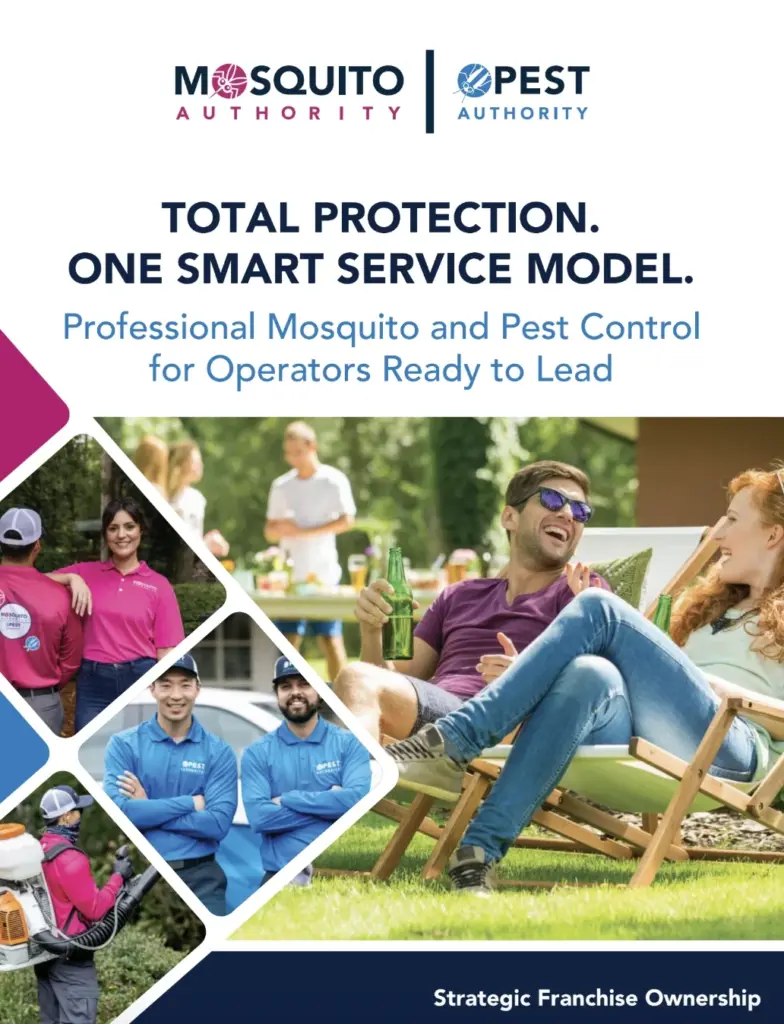
Mosquito Authority & Pest Authority run two service paths under one franchise family. You can focus on mosquito control through Mosquito Authority, or offer full-service pest protection through Pest Authority.
The support does not stop at launch. Franchisees use technology-enabled tools for scheduling, service tracking, billing, and customer communication. Field operations stay organized as your team grows. That shared structure is what keeps service quality consistent across a whole network.
Why Pest Control Is a Resilient Franchise Industry
Pest control franchises make a strong investment because demand is steady and largely recession-resistant. Homes and businesses need protection every season, which supports recurring revenue. Recurring revenue is income you collect on a repeating schedule, such as a monthly or seasonal service plan.
Because pests return year after year, that demand rarely disappears in a downturn.
The NPMA 2025 industry growth report shows the U.S. structural pest control industry generated $13.416 billion in service revenue in 2025. That’s a 6% increase from 2024’s $12.654 billion, with recurring revenue making up 85.4% of residential service revenue.
Franchising overall keeps growing too. The IFA 2026 Franchising Economic Outlook projects U.S. franchise output will rise from $907.3 billion to $921.4 billion, an increase of 1.6%, in 2026.
Brand recognition adds another layer of confidence for buyers. Both brands earned spots on the Entrepreneur 2026 Franchise 500. Pest Authority ranked #250, and Mosquito Authority ranked #391.
Demand also spreads across both homes and businesses, which softens seasonal swings. A residential mosquito plan may peak in warm months, while commercial pest contracts run all year. That mix gives owners more than one revenue source to lean on.
Recurring service plans are the engine here. The brand’s Authority Advantage Bundles package year-round coverage into simple, repeating programs, which is a pattern you see across the best recurring-revenue home services.
What Does a Pest Control Franchise Cost?
Steady demand only pays off if the entry price fits your budget, so here is what you actually pay.
The cost breaks into a few parts. You pay the initial franchise fee, then a total initial investment that covers equipment, a vehicle, licensing, and working capital. After launch, you pay an ongoing royalty on your revenue.
Mosquito Authority has a total initial investment of $54,000–$127,700. Its initial franchise fee runs from $25,000 for a Hometown territory to $45,000 for a Full-Size territory. The monthly royalty is 10% of gross revenues.
Pest Authority sits a bit lower. Its total initial investment is $40,500–$105,700, with an initial franchise fee of $12,500 to $25,000 and a royalty of 7.5% of gross revenues.
Discounts can lower your entry cost. Honorably discharged veterans receive a 15% discount on the initial fee, and you can learn more about veteran franchise incentives directly.
Owners who sign a second or additional territory at the same time receive a 30% discount on those initial fees. In addition, these fees include initial training for up to five people.
Here is how representative brands compare on total initial investment.
| Franchise | Initial Investment Range |
| Mosquito Authority | $54,000–$127,700 |
| Pest Authority | $40,500–$105,700 |
| Mosquito Shield | $98,500–$139,950 |
| Mosquito Joe | $102,850–$193,075 |
| Mosquito Squad | $164,530–$217,125 |
| Critter Control | $83,550–$240,275 |
| Pestmaster | $84,600–$188,800 |
Figures come from each brand’s disclosures and franchise pages and can change over time.
Financing can bridge the gap if you do not fund the whole investment yourself. The brand introduces owners to funding options that can cover a business up to $150,000. Money can become available in as little as 90 days. Planning for working capital early keeps your first months of operations steady while you build a customer base.
How Profitable Is a Pest Control Franchise?
Once you know the investment, the next question is what it returns. Profit in pest control comes from repeat service contracts that bill month after month. Tight route density and strong customer retention also lift margins.
Add-on services, such as upgrading a mosquito plan to broader coverage, raise the value of each account.
Our own numbers show the pattern. Mosquito Authority’s latest Franchise Disclosure Document (Item 19) reports an average gross revenue of $464,599.95 among 128 franchisees who operated continuously through 2023 and 2024. This is a historical average, not a promise of future earnings, and individual results vary by market and individual effort.
“Recurring service is one of the strengths of the model because it creates opportunities to build longer-term customer relationships and more predictable revenue over time,” says Bobby Rycroft, VP of Growth and Strategy at Mosquito Authority & Pest Authority Franchising. “By bundling services across seasons, franchisees can increase customer value while helping homeowners maintain year-round protection.”
Top Pest Control Franchises to Compare
Those cost and profit figures make more sense next to competitors. Several well-known brands compete in this space, and the table below keeps the comparison factual. It lists each brand’s focus and total initial investment so you can weigh entry cost against service model.
| Franchise | Focus | Initial Investment |
| Mosquito Authority | Mosquito control | $54,000–$127,700 |
| Pest Authority | Full-service pest protection | $40,500–$105,700 |
| Mosquito Joe | Mosquito control | $102,850–$193,075 |
| Mosquito Squad | Mosquito control | $164,530–$217,125 |
| Critter Control | Wildlife and pest control | $83,550–$240,275 |
Two points stand out for the Authority brands. Entry cost starts lower than most mosquito-only competitors, and you can pick mosquito control or full-service pest protection under the same family. You can read more about Mosquito Authority and how the dual-brand model works.
How to Choose and Start a Pest Control Franchise
Start your evaluation with the Franchise Disclosure Document, or FDD. The FDD is the legal document a franchisor must give you before you invest, spelling out fees, obligations, litigation history, and financial performance. The FTC Franchise Rule requires franchisors to provide a disclosure document containing 23 specific items of information.
Timing matters as much as content. The FTC Amended Franchise Rule FAQs also set the delivery timing.
Franchisors must give you the FDD at least 14 calendar days before you sign any agreement or pay any money. Use that window to read every item and ask questions.
Look closely at territory rights, the royalty structure, technology, and the depth of training. A strong system pairs certified standards with day-to-day coaching, which you can see in the brand’s franchisee training and support. Every owner and technician completes the Pro Authority certification program, and KPI benchmarks guide performance.
“Take the time to understand both the financial performance represented in Item 19 and the territory you’re investing in,” says Amy Hamm, Vice President of Business Operations & Franchise Management at Mosquito Authority & Pest Authority Franchising. “Your market size, customer opportunity, and protected territory all play a role in how you build and grow the business, so those details deserve just as much attention as the brand itself.”
Talk to current franchisees before you commit. This validation step lets you ask real owners about revenue, support, workload, and daily operations. It grounds your decision in experience rather than a sales pitch.
Once you choose a brand, the startup steps are practical. Secure financing and complete your initial training. Then obtain the pest control licenses your state requires.
Most licensing runs through the state Department of Agriculture and follows EPA pesticide rules. After that, you set up operations and launch local marketing ahead of a grand opening.
Mosquito Control vs. Full-Service Pest Protection
The two paths fit different goals. Mosquito control focuses on mosquitoes and ticks, which makes it seasonal in many regions and friendly to upsells as customers add coverage. That creates a focused entry point with a clear service story.
Full-service pest protection covers a broader pest list and runs year-round, which smooths revenue across the calendar. It suits owners who want steady demand in every season and larger service contracts.
Your local market can point you toward the right fit. A warm-climate suburb with heavy mosquito pressure may reward a mosquito-first launch, while a mixed residential and commercial area may favor full-service coverage. You can also start with one path and add the other as your territory grows.
You do not have to pick blindly. Both paths run under one franchise family, so you can match your choice to your market and budget.
Frequently Asked Questions
How much does a pest control franchise cost?
Total initial investment generally runs $40,500–$105,700 for Pest Authority and $54,000–$127,700 for Mosquito Authority, plus an initial franchise fee and ongoing royalty.
Is owning a pest control franchise profitable?
Profitability depends on recurring contracts and route density. Mosquito Authority’s Item 19 reports an average gross revenue of $464,599.95 across 128 franchisees, a historical average that individual results will vary from.
What licenses and permits do I need to open a pest control franchise?
Most states require a commercial pesticide applicator license through the state Department of Agriculture, under EPA rules, so requirements vary by state.
Which pest control franchises offer veteran discounts?
Mosquito Authority & Pest Authority give honorably discharged veterans a 15% discount on the initial franchise fee.
What should I look for in a franchise disclosure document (FDD)?
Review the fees, royalty structure, territory rights, and the Item 19 earnings data, and confirm you received the FDD at least 14 days before signing.
Ready to Own the Authority in Pest Control?
Pest control franchises pair steady demand and recurring revenue in a proven dual-brand system, which lowers the risk of going it alone. Whether you lean toward mosquito control or full-service pest protection, one franchise family lets you start focused and expand into new territories over time.
Want the full picture before you decide? Get our FREE eBook to see the full costs and the numbers that shape ownership. Then take the next step toward owning the Authority in pest control.